Missing teeth change more than just a smile — they alter how you eat, speak, and even how your face holds its shape. Today’s dental implants are designed to restore lost teeth in a way that protects the surrounding anatomy and returns reliable function. Unlike older options that sit on top of the gums or rely on neighboring teeth for support, implants integrate with the jawbone to create a foundation that behaves much like a natural tooth root.
Implants are made from biocompatible materials and are engineered to encourage bone integration, which helps maintain facial structure and prevents the sunken look that can occur after tooth loss. For many patients they provide a durable, long-term solution that supports crowns, bridges, and removable prostheses with greater stability and comfort. Because implants replace the root as well as the visible tooth, they preserve the forces of biting and chewing in a healthier way than conventional alternatives.
At Capitol Smiles we emphasize careful diagnosis and planning so each implant is positioned for both strength and natural appearance. Treatment begins with imaging and a review of your overall oral health to determine whether implants are the right option for your situation. From single-tooth replacement to solutions for full-arch rehabilitation, implants offer a versatile path to rebuilding a confident, functional smile.
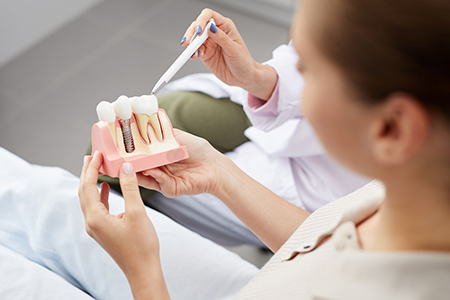
Dental implants rely on a process called osseointegration, where the implant surface bonds with the surrounding bone. This biological connection produces a stable anchor that can withstand normal chewing forces for many years. Implant systems and surface technologies have evolved substantially, improving predictability and long-term outcomes for patients with a wide range of needs.
Successful implant therapy depends on more than the hardware. It also requires a comprehensive treatment plan that accounts for bite relationships, the quality and quantity of bone, soft tissue health, and esthetic goals. Advanced imaging and digital planning tools allow clinicians to map out precise implant positions and anticipate restorative needs before placing a single implant.
Post-placement care and good oral hygiene are integral to longevity. Patients who maintain regular dental check-ups and clean their implants properly can expect durable performance. When properly planned and cared for, implants offer a level of function and comfort that closely mirrors natural teeth.
One of the most compelling advantages of implants is how naturally they function. Because implants serve as root replacements, they transmit chewing forces into the jawbone, preserving bone volume and helping maintain facial contours. This contrasts with removable dentures, which can accelerate bone loss because they rest on the gum surface rather than stimulating the underlying bone.
Implants also deliver improved stability. Implant-supported crowns and bridges are fixed or securely attached, eliminating the movement and adhesive dependence sometimes associated with traditional dentures. This stability translates to greater comfort while speaking, chewing, and during daily life.
Another practical advantage is conservation of adjacent teeth. In many cases, replacing a missing tooth with an implant avoids the need to prepare neighboring healthy teeth for bridgework, preserving more of your natural dentition. All of these benefits combine to make implants a preferred, long-term restorative option for many patients.
When a single tooth is missing, an implant topped with a custom crown restores form and function while leaving neighboring teeth untouched. This approach recreates an individual tooth's natural biomechanics and appearance, offering a discreet and stable result that blends seamlessly with adjacent teeth. For many patients, a single implant is the most conservative restorative choice.
The restorative crown is color-matched and sculpted to harmonize with your smile, while the implant itself sits below the gum line to support proper soft-tissue contours. Because the replacement mimics both root and crown, patients usually find the result both comfortable and easy to care for as part of a normal oral hygiene routine.
When two or more adjacent teeth are missing, an implant-supported bridge uses strategically placed implants to support a span of replacement teeth without relying on neighboring natural teeth for support. This preserves healthy tooth structure that would otherwise be altered for a traditional fixed bridge and provides better long-term bone maintenance in the area.
Implant-supported bridges can be designed to meet specific esthetic and functional goals, whether restoring a small segment of the mouth or addressing more extensive tooth loss. The result is a stable, fixed restoration that enables confident chewing and natural speech.
For patients missing most or all teeth in an upper or lower arch, contemporary implant protocols allow for full-arch rehabilitation using a limited number of implants to support a complete set of fixed teeth. These solutions deliver a permanent-feeling alternative to conventional dentures and can be designed for immediate temporary teeth followed by final prostheses once integration is complete.
Full-arch options vary by case and may include non-removable fixed bridges or hybrid prosthetics that are securely attached to implants. The primary goals are to restore chewing function, speech, and esthetics while creating a comfortable, stable solution that integrates with the patient’s facial profile.
For patients who prefer a removable prosthesis, implant-retained overdentures provide a significant improvement in retention and comfort compared with traditional dentures. A small number of implants are used as attachment points, giving the denture a firm connection and reducing the risk of shifting or slippage while eating or speaking.
This option often appeals to patients who want the security of implants combined with the convenience of a removable appliance for cleaning. Implant-retained dentures are a practical and conservative solution that enhances everyday confidence and function.
Implants are an option for many adults, but candidacy depends on a few key factors: overall health, oral hygiene, and the quantity and quality of jawbone at the intended implant site. Conditions such as uncontrolled diabetes or habits like heavy smoking can affect healing and implant success, so a careful medical and dental review is essential. In many cases, lifestyle changes or medical management can improve candidacy.
Even when bone volume is reduced after tooth loss, modern grafting and regenerative procedures often make implants possible. A thorough evaluation — including 3D imaging where indicated — helps determine the best path forward and whether any preparatory treatments are advisable.
Successful implant dentistry begins with diagnostic planning. Digital imaging and clinical exams guide decisions about implant size, position, and the type of restoration that will achieve the best functional and esthetic outcome. This planning phase also addresses the shape and health of the soft tissues around the implant to ensure a natural-looking emergence profile for the final tooth or teeth.
Transparent communication about the sequence of care helps patients know what to expect at each stage: consultation and imaging, surgical placement, healing and integration, and final restoration. Most placements are performed on an outpatient basis, and anesthesia or sedation options are discussed so patients can be comfortable throughout the procedure.
Bone grafting restores lost bone volume and creates a stable foundation for implant placement when natural bone is insufficient. This can be necessary after tooth loss, periodontal disease, or trauma. Grafting materials and techniques vary, and the chosen approach depends on the amount of augmentation required and the long-term goals for the restoration.
When grafting is performed, it may extend the overall timeline of treatment, but it also improves the likelihood of predictable, long-lasting implant success. Many grafts integrate well and provide the support needed for secure implant placement and optimal esthetic results.
Healthy gums are essential for both the look and function of implant restorations. In some cases, soft-tissue grafting or contouring may be recommended to create balanced, symmetrical gum lines and promote tissue stability around the implant. These measures contribute to a natural emergence profile and help maintain long-term health around the implant site.
Esthetic planning is particularly important in the visible zone of the smile. By coordinating implant position with the final prosthetic design, clinicians can achieve outcomes that look and feel natural while meeting the patient’s cosmetic objectives.
Dental implants offer a durable, versatile, and biologically sound way to replace missing teeth. From single crowns to full-arch restorations, modern implant dentistry provides options that prioritize function, appearance, and long-term oral health. The best approach is individualized — based on your anatomy, goals, and overall health — and planned with precision to achieve predictable results.
If you’d like to learn whether implants are right for your smile, our office is available to answer your questions and walk you through the diagnostic process. Contact us for more information and to schedule a consultation with our team.

If you've lost a tooth due to injury, decay, gum disease, or any other reason, we recommend dental implants to replace missing teeth. Dental implants come the closest to replicating the look, feel, and function of your natural teeth.
Dental implants are placed into the jawbone and mirror the same function as the root of a tooth. The procedure for dental implants is usually performed while a patient is sedated. Patients who undergo IV sedation must have an empty stomach and transportation home following the procedure. Most sedation patients will have little to no memory of the procedure occurring.
Generally, dental implants are made out of a biocompatible metal such as titanium. Biocompatible metals are also used for other common bone implants (such as shoulder, hip, and knee replacements). The visible portion of the implant is usually made out of porcelain and is custom-made to match your existing teeth.
Dental implants are designed to fuse to the bone, which makes them become permanent fixtures. Typically speaking, the success rate is nearly 100%. There are few cases in which the implant will not fuse as intended and must be removed. If this happens to occur, the procedure can be attempted again a few months later.
Dental implants are not usually covered by dental insurance, but may be covered under a patient's medical insurance. Our office and your insurance company can discuss coverage options with you based on your individual case and treatment plan.
It's easy... just take care of an implant as if it's a natural tooth! This involves regular brushing, flossing, and dental checkups. If you have any concerns about your implant, contact us immediately.
Dental implants are medical-grade posts that are placed into the jawbone to replace missing tooth roots and provide support for restorations such as crowns, bridges, or dentures. After placement the implant integrates with the surrounding bone through a biological process called osseointegration, creating a stable foundation that behaves much like a natural tooth root. Because implants restore both root and crown function, they help preserve bone and maintain facial contours compared with solutions that rest only on the gums.
Implant therapy is a team approach that combines surgical placement with prosthetic restoration, and each phase is planned to achieve long-term function and esthetics. Modern implant systems and surface treatments have improved predictability and durability, making implants a mainstream option for many patients. Successful outcomes depend on proper planning, precise placement, and appropriate oral hygiene and maintenance.
Implants restore the missing root structure as well as the visible tooth, which allows chewing forces to be transmitted to the jawbone and helps prevent the bone loss that can follow tooth extraction. This preservation of bone volume supports facial structure and often results in a more natural feel and appearance compared with removable dentures that rest on the gums. Implant-supported restorations are also usually more stable, reducing movement and improving comfort for speaking and eating.
In many cases implants allow clinicians to avoid altering healthy adjacent teeth, which is sometimes necessary when placing a traditional fixed bridge. Implant-supported bridges and full-arch restorations can provide fixed or securely attached solutions that combine improved function with long-term preservation of surrounding tissues. Taken together these features make implants a durable and biologically sound choice for many restorative needs.
Many adults are candidates for dental implants, but candidacy depends on overall health, oral hygiene, and the quantity and quality of jawbone where the implant is planned. Conditions that impair healing—such as uncontrolled diabetes—or habits like heavy smoking can affect success rates, so a comprehensive medical and dental review is part of the evaluation. Even when bone volume is reduced, modern grafting and regenerative techniques frequently make implant placement possible.
A thorough diagnostic workup, including clinical exam and imaging, helps determine candidacy and whether any preparatory procedures are recommended. Treatment planning also considers bite relationships, soft tissue health, and esthetic goals to ensure the selected solution meets functional and cosmetic needs. When appropriate, patients are guided through lifestyle or medical steps that can improve the likelihood of successful integration.
Accurate planning begins with a detailed clinical exam and radiographic imaging to evaluate bone volume, tooth position, and important anatomical structures. Many clinicians use three-dimensional imaging (CBCT) and digital scanning to visualize the jaw in precise detail and to simulate optimal implant positions before surgery. These technologies allow the team to anticipate restorative requirements and to design implant placement that supports a natural emergence profile and long-term function.
Digital planning tools also support guided surgery and prefabrication of provisional restorations in select cases, which can improve efficiency and predictability. The diagnostic phase includes discussion of anesthesia or sedation options and a clear sequence of care so patients know what to expect at each stage. Transparent communication about healing timelines and follow-up care helps ensure consistent outcomes.
Implant dentistry offers a range of restorative options tailored to different needs, from single-tooth crowns to implant-supported bridges and removable overdentures. A single implant with a custom crown replaces one missing tooth without altering adjacent teeth, while implant-supported bridges use multiple implants to support several consecutive missing teeth. For patients missing an entire arch, fixed full-arch bridges or hybrid prostheses can recreate a complete set of teeth that is anchored to a limited number of implants.
Removable implant-retained overdentures are another option for patients who prefer the convenience of a prosthesis that can be taken out for cleaning while enjoying improved stability over conventional dentures. The chosen restoration depends on the patient’s anatomy, functional needs, and esthetic goals, and the treatment plan is individualized to balance longevity and comfort. Your clinician will explain the expected function and maintenance requirements for each option during planning.
Treatment typically follows a stepwise sequence that begins with consultation and imaging, proceeds to surgical placement of the implant, and concludes with fabrication and attachment of the final restoration. After placement, a healing period allows the implant to integrate with the bone; the duration of this period varies by case and may be shorter or longer depending on bone quality and whether additional procedures were performed. In some cases provisional teeth are provided so patients have function and esthetics while healing continues.
Surgical placement is commonly performed on an outpatient basis with local anesthesia and optional sedation to ensure comfort. Follow-up visits monitor healing and soft-tissue response, and once integration is confirmed the restorative phase begins with impressions or digital scans for the final crown, bridge, or prosthesis. The clinician will outline a personalized timeline at the consultation so patients understand expected milestones and aftercare requirements.
Bone grafting may be recommended when there is insufficient jawbone volume to securely support an implant, which can occur after tooth loss, periodontal disease, or trauma. Grafting procedures use either autogenous bone, donor bone, or bone substitute materials to rebuild the ridge and create a stable foundation for implant placement. The extent of grafting ranges from minor localized augmentation to larger ridge reconstruction, and the chosen technique depends on the clinical goals and available tissues.
Soft-tissue grafting or contouring can also be important for esthetics and long-term tissue stability, especially in the smile zone where gum shape influences appearance. These procedures aim to create balanced, healthy gum lines and to support natural emergence of the restoration. While grafting can extend the overall timeline, it often improves predictability and esthetic outcomes for implant-supported restorations.
Daily oral hygiene remains essential for implant longevity; patients should brush thoroughly and use interdental cleaning tools to remove plaque around implant restorations. Professional maintenance with regular dental exams and cleanings allows clinicians to monitor the implant, surrounding tissues, and prosthetic components for early signs of trouble. Consistent follow-up helps detect and manage soft-tissue inflammation or other issues before they progress.
Healthy habits such as avoiding tobacco use and managing systemic conditions that affect healing also support long-term success. If an implant restoration includes removable components, the dentist will provide specific cleaning and handling instructions to protect attachment mechanisms. With proper home care and periodic professional oversight, implants can provide durable function that closely resembles natural teeth.
Complications are relatively uncommon when implant therapy is properly planned, but they can include infection, inadequate integration, or soft-tissue problems such as peri-implant mucositis and peri-implantitis. Early detection through routine exams and radiographs is important because many complications respond well to prompt intervention, which may include localized cleaning, antimicrobial therapy, or revision procedures. Maintaining good oral hygiene and attending scheduled maintenance visits reduces the likelihood of long-term problems.
In cases where integration fails or components are damaged, clinicians can often revise the site with additional procedures such as bone grafting or replacement of the implant or prosthesis. Risk is minimized by careful case selection, thorough diagnostic imaging, and adherence to evidence-based protocols. Your dental team will review potential risks and the planned measures to mitigate them during the consultation so you can make an informed decision.
At your initial consultation the team will review your medical and dental history, perform a clinical exam, and obtain necessary imaging to evaluate bone, soft tissues, and occlusion. The clinician will discuss suitable restorative options, the sequence of care, anesthesia or sedation choices, and any preparatory treatments that may be recommended to optimize outcomes. This visit is an opportunity to ask questions about expected function, esthetics, and the steps involved in the proposed plan.
At Capitol Smiles in Frankfort the consultation is designed to provide clear information and a personalized recommendation based on your anatomy and goals. If you decide to proceed, the practice will schedule the diagnostic and surgical appointments and outline post-operative instructions and follow-up care. A well-defined plan and open communication help ensure predictable results and a positive treatment experience.
Quick Links